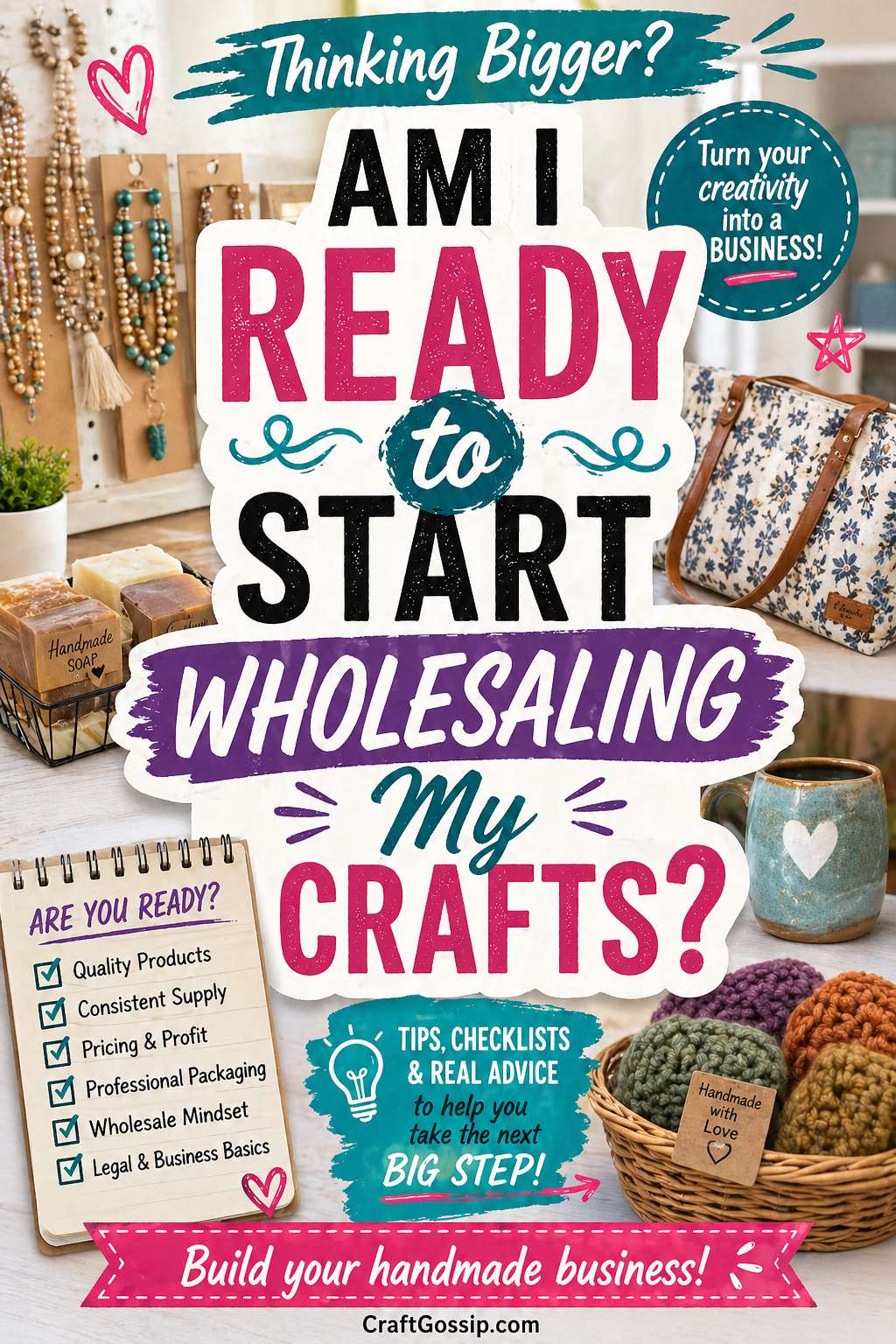
There comes a point in many handmade businesses where you start wondering whether it is time to move beyond one-at-a-time sales and step into the world of wholesale.
Maybe a local boutique has asked if they can stock your handmade candles. Maybe your Etsy shop is ticking along nicely and you are getting repeat orders. Maybe you have had that lovely little daydream where your products are lined up beautifully on shop shelves, looking all professional and grown-up while you sip your coffee and pretend you are not checking your sales every five minutes.
Wholesaling your crafts can be a brilliant next step for indie makers, artists, and handmade business owners, but it is not simply “sell more things and make more money.” Wholesale comes with bigger orders, tighter margins, production deadlines, packaging requirements, and a whole lot more admin than most makers expect.
And let’s be honest, if you are currently making everything on the dining table between school pick-ups, dinner, and hunting for the good scissors, wholesale needs a little bit of planning before you say yes to that first big order.
So how do you know if you are ready to start wholesaling your handmade products?
Let’s walk through the signs, the questions to ask yourself, and the practical things you need to have in place before you jump in.
What Does Wholesale Mean for Handmade Sellers?
Wholesale means selling your handmade products in bulk to retailers, boutiques, gift shops, galleries, online stores, or subscription box companies. Those businesses then sell your products to their own customers at a retail price.
For example, if you usually sell a handmade item for $30, a retailer may expect to buy it from you at around 50% of the retail price so they can mark it up and make their own profit.
That is the part many makers forget at first. Wholesale is not just more sales. It is more sales at a lower price per item, which means your pricing, time, materials, packaging, and production process all need to make sense before you take the plunge.
Why Handmade Businesses Consider Wholesale
Wholesale can be a lovely way to grow your handmade business because it allows you to get your products in front of more people without needing to find every single customer yourself.
Instead of selling one item at a time, you may sell 20, 50, or 100 pieces in one order. That can create more consistent income, introduce your brand to new audiences, and help you build relationships with retailers who genuinely love handmade products.
Wholesale can also be helpful if your products are giftable, easy to display, repeatable to make, and suited to shops that already serve your ideal customer.
This is especially true for handmade items such as:
- candles and bath products
- handmade jewelry
- greeting cards and stationery
- ceramics and pottery
- sewn accessories
- craft kits
- art prints
- handmade home decor
- seasonal gifts
- baby gifts
- small-batch skincare
- crochet or knitted accessories
But before you start dreaming about your products in every gift shop from here to the coast, let’s make sure the numbers and the workload actually work.
1. You Have Consistent Demand for Your Products
One of the strongest signs you may be ready for wholesale is steady demand.
If your handmade products are selling regularly, customers are coming back for more, and people are asking whether shops can stock your items, that is a good sign there is a market beyond your direct customers.
This does not mean you need to be wildly famous or selling out every week. But you should have proof that people want what you make.
Ask yourself:
- Do I have repeat customers?
- Do certain products sell consistently?
- Have retailers or stockists shown interest?
- Do customers buy these items as gifts?
- Do I receive positive reviews or social media shares?
- Can I clearly identify my best-selling products?
If you are still testing different ideas and only making random one-off pieces, wholesale may be a little early. Retailers usually want products they can reorder, not a completely different surprise every time. Handmade can absolutely still feel special, but wholesale works best when there is some consistency.
2. You Can Make Your Products More Than Once
This is the big one.
Wholesale requires repeatability. A shop does not want one beautiful item that you can never make again. They want a reliable product line they can order, display, sell, and reorder.
If you are making handmade jewelry, can you source the same beads again? If you are sewing bags, can you buy more of the same fabric or offer a consistent style in different prints? If you make candles, do you have a reliable scent blend, jar supplier, and label design?
Before wholesaling, make sure you can reproduce your products without losing your mind or turning your craft room into a danger zone of half-packed boxes and panic.
A good wholesale-ready product should be:
- repeatable
- easy to price
- reliable to package
- suitable for shipping
- consistent in quality
- not overly time-consuming to make
- attractive on a retail shelf
This is where simplifying your product range can help. You do not need to wholesale everything you make. In fact, please do not. Choose your strongest, most repeatable products and build a small wholesale collection around those.
3. Your Pricing Still Makes Sense at Wholesale Rates
Wholesale pricing is where many handmade sellers get a nasty surprise.
If your retail price only just covers your materials and time, there is no room for wholesale. You need enough margin to sell at a lower wholesale price and still make a profit.
A simple starting point is:
Retail price = wholesale price x 2
So if a retailer buys your product for $15, they may sell it for around $30.
But your wholesale price still needs to cover:
- materials
- packaging
- labels
- labour
- overheads
- payment fees
- shipping supplies
- your profit
And yes, your time counts. Please do not pay yourself in “exposure” and leftover ribbon.
If it takes you two hours to make something and the wholesale price leaves you with $3 profit, that is not a wholesale product. That is a fast track to burnout with prettier packaging.
Before offering wholesale, sit down and work out your true costs. Be honest about your time, even if you love making the item. Loving the work does not mean doing it for free.
4. You Have a Clear Best-Selling Product Line
Wholesale buyers like clarity. They want to understand what your brand is, who your products are for, and which items are likely to sell in their shop.
If your handmade business is a little bit of everything — candles, earrings, crochet hats, resin trays, bookmarks, soap, and the odd painted pot because you got bored one weekend — it may be harder for retailers to understand your range.
You do not need to box yourself in forever, but you do need a focused wholesale collection.
A strong wholesale line might include:
- 6–12 best-selling products
- a few colour or scent variations
- clear product names
- consistent branding
- professional packaging
- simple reorder options
- seasonal items if relevant
This is also where product photography matters. If you are approaching retailers, your images need to show the item clearly, not lying on a cluttered bench next to your coffee cup and a suspicious-looking glue stick.
If you need more help improving product presentation, this is a good place to internally link to a CraftGossip article on product photography, Etsy shop tips, or handmade business branding.
5. You Understand Minimum Order Quantities
Wholesale usually involves a minimum order quantity, often called an MOQ. This is the smallest order a retailer must place to buy from you at wholesale pricing.
Your MOQ needs to make sense for your business.
For example, you might set:
- minimum opening order: $150
- minimum reorder: $75
- minimum quantity per product: 4 or 6 units
This stops you from doing wholesale pricing for tiny orders that are not worth the admin, packing, and discounted rate.
The exact amount depends on your product type, price point, and production capacity. A maker selling handmade earrings may set different minimums from someone selling handmade quilts or ceramics.
Keep it simple at first. You can always adjust your wholesale terms as you learn what works.
6. You Can Handle Larger Production Runs
Making 5 items is not the same as making 50. Ask any crafter who has ever said “I’ll just make these for the school fair” and then found themselves surrounded by glue, thread, and regret at midnight.
Wholesale requires you to produce larger quantities while keeping the quality consistent.
Before accepting wholesale orders, ask yourself:
- How long does each item take to make?
- How many can I realistically produce in a week?
- Do I have enough workspace?
- Can I order materials in bulk?
- Do I need help with packing or labelling?
- Can I keep up with retail and wholesale orders at the same time?
- What happens if a supplier runs out of a key material?
Do a test production run before offering wholesale. Make 20 or 30 of the same item and time yourself. Track how much material you use, how long packaging takes, and whether you still enjoy making the item after the tenth one.
That little test can save you from promising an order you cannot comfortably fulfil.
7. Your Packaging Looks Retail-Ready
Retail packaging matters. Your handmade products need to look attractive, professional, and easy for a customer to understand when displayed in a shop.
That does not mean expensive. It means clear, tidy, practical, and on-brand.
Retail-ready packaging may include:
- product labels
- care instructions
- ingredients or materials list where needed
- barcode if required by the retailer
- hang tags
- branded backing cards
- simple display packaging
- safety information for candles, skincare, or children’s items
Think about how your item will sit on a shelf, hang on a rack, or be displayed near a checkout. Retailers love products that are easy to merchandise.
This is also a good spot for an affiliate-style supply mention if suitable:
If you are preparing for wholesale, investing in a good label printer, sturdy shipping boxes, and simple branded packaging supplies can save you a lot of stress later. They are not the glamorous side of handmade business, but they make you look wonderfully organised.
8. You Know Who Your Ideal Retailers Are
Not every shop is the right shop for your handmade products.
One of the biggest mistakes makers make is pitching to every boutique, gift store, and online shop they can find. It is much better to target retailers whose customers already match your product style and price point.
Ask yourself:
- Where would my ideal customer shop?
- What types of stores already sell products like mine?
- Does my pricing fit their shop?
- Does my packaging suit their style?
- Would my products sit naturally with their current range?
- Are they known for supporting handmade or small-batch brands?
If your work is earthy, slow-made, and natural, a bright novelty gift shop may not be the best fit. If your products are playful and colourful, a minimalist luxury boutique may not be your people. And that is perfectly fine.
Wholesale works best when the retailer, product, and customer all make sense together.
9. You Have a Wholesale Line Sheet or Catalogue
A wholesale line sheet is a simple document that shows retailers what you sell and how to order.
It does not need to be fancy, but it does need to be clear.
Your wholesale line sheet should include:
- business name and contact details
- short brand introduction
- product photos
- product names
- wholesale prices
- suggested retail prices
- minimum order requirements
- colour, size, or scent options
- order quantities
- payment terms
- turnaround time
- shipping information
- return or damage policy
A digital PDF is usually enough when you are starting out. Keep it clean and easy to read. Retail buyers are busy, and they should not have to dig through a novel to find your prices.
10. You Are Ready for Clear Terms and Boundaries
Wholesale is exciting, but it is still business. You need clear terms before anyone places an order.
Decide in advance:
- Do you require payment upfront?
- Do you offer payment on invoice?
- What is your turnaround time?
- Who pays shipping?
- What happens if items arrive damaged?
- Can retailers return unsold stock?
- Can shops sell your products online?
- Do you allow discounting?
- Do you offer exclusivity by suburb or region?
You do not need a complicated legal document to begin with, but you do need written terms. It protects both you and the retailer.
A friendly business boundary is still a boundary. You can be warm, creative, and lovely while also saying, “Payment is required before production begins.” Magic words, those.
11. You Can Communicate Like a Business Owner
Good wholesale relationships depend on good communication.
Retailers need to know when their order will ship, what is available, what is out of stock, and how to reorder. If there is a delay, tell them early. If you are discontinuing a product, let them know. If you are launching seasonal items, give them enough time to plan.
This is not about being stiff or corporate. It is about being reliable.
Simple things make a big difference:
- reply to wholesale enquiries promptly
- send clear order confirmations
- keep buyers updated
- include tracking details
- package orders neatly
- follow up after delivery
- make reordering easy
Retailers remember makers who are easy to work with. That can lead to repeat orders, referrals, and long-term stockist relationships.
12. You Are Financially Prepared for the Shift
Wholesale can improve cash flow, but it can also require upfront spending.
You may need to buy larger amounts of materials, upgrade packaging, order labels, improve photography, create catalogues, attend markets or trade shows, or get help with production.
Before you jump in, check whether you have enough financial breathing room to handle bigger orders without putting yourself under pressure.
It is perfectly okay to start small. You do not need 50 stockists in your first year. A few good wholesale accounts can be much more valuable than lots of stressful ones.
5 Signs You Might Be Ready to Wholesale Your Handmade Products
If you are still unsure, here are five signs that wholesale could be a good next step.
You already have steady sales
Your products sell regularly and you have a clear idea of what customers love most.
Retailers have shown interest
Shops, boutiques, galleries, or subscription boxes have asked about stocking your products.
You can produce in batches
You can make multiples without sacrificing quality or spending every waking hour at your craft table.
Your pricing allows for profit
Your wholesale price still leaves room for materials, labour, overheads, and profit.
Your branding feels shop-ready
Your packaging, photography, and product range look polished enough to sit on a retail shelf.
When You Might Not Be Ready for Wholesale Yet
Wholesale is not the only way to grow a handmade business. Sometimes it is better to strengthen your direct sales first.
You may want to wait if:
- your pricing is too low
- your products take too long to make
- you cannot source materials reliably
- your packaging is not ready
- you are already struggling to keep up with orders
- you do not know your best-selling products yet
- you are unsure who your ideal customer is
- you feel pressured into saying yes
There is no shame in waiting. In fact, waiting until your business is ready can save you money, stress, and a lot of late-night panic-making.
Beginner Wholesale Checklist for Handmade Sellers
Before you approach retailers, make sure you have:
- a focused product range
- wholesale and retail pricing
- minimum order quantities
- clear product photos
- retail-ready packaging
- a wholesale line sheet
- written terms and conditions
- reliable suppliers
- realistic turnaround times
- a system for tracking orders
- sturdy shipping supplies
- clear communication templates
You do not need everything perfect. Handmade businesses grow in stages. But you do need enough structure that a wholesale order feels exciting rather than terrifying.
FAQ: Wholesaling Handmade Crafts
What is wholesale for handmade products?
Wholesale is when you sell your handmade products in larger quantities to retailers at a discounted price. The retailer then sells those products to customers at the retail price.
How much should I charge for wholesale?
A common wholesale pricing approach is to set your wholesale price at around 50% of your retail price. However, this only works if your pricing already includes enough margin to cover materials, labour, overheads, and profit.
Do I need a wholesale catalogue?
Yes, a simple wholesale line sheet or catalogue is very helpful. It should show your products, prices, minimum order quantities, turnaround times, and ordering details.
How do I find shops to stock my handmade products?
Start by researching boutiques, gift shops, galleries, museum shops, online retailers, and local stores that already sell products with a similar style or audience. Personalised emails usually work better than sending the same pitch to everyone.
Should I wholesale through Etsy?
Etsy can be useful for retail sales and brand discovery, but for wholesale you may prefer direct retailer relationships or wholesale platforms. Make sure your pricing and production process are ready before offering bulk discounts.
What handmade products are good for wholesale?
Products that are repeatable, giftable, easy to package, and not too time-consuming to make are usually better suited to wholesale. Candles, soaps, cards, jewelry, art prints, small accessories, and craft kits can all work well if priced correctly.
Is wholesale better than selling direct to customers?
Not always. Selling direct usually gives you a higher profit per item, while wholesale can give you larger orders and wider exposure. Many handmade businesses do both.


Leave a Reply